English prepositions are weird. Like, really weird. And nowhere is this more obvious than when you're trying to explain whether you're "in" a meeting or "at" a meeting. Both sound right, both get used all the time, but they actually mean different things. If you've ever second-guessed yourself while typing a message about a meeting, you're not alone. Let's break down the difference so you never have to wonder again.
Key takeaways
- 'In the meeting' means you're actively participating, while ' at the meeting' just means you showed up
- Virtual platforms like Kumospace are changing how we think about meeting presence entirely
- Getting your apostrophes right in phrases like 'today's meeting' matters more than you think
- Context is everything when choosing between formal and casual meeting language
Navigating the meeting space: 'in' vs. 'at'

Imagine you’re half listening to a Q2 slide deck when a friend texts, “Where are you?” Saying you’re at a meeting sounds casual and physical, like you’re just present in the room. Saying you’re in a meeting signals involvement, that you’re actively part of what’s happening. Both are correct, but the choice subtly changes how engaged you sound.
Defining presence: ‘at the meeting'
When you say you're "at the meeting," you're talking about your physical location. You're in the building, in the room, at the event. It's like saying "I'm at the grocery store" or "I'm at the gym." You're there in body, but it doesn't really say anything about what you're actually doing.
Use "at the meeting" when you want to emphasize:
- Where you physically are
- The location or venue of the meeting
- Simple attendance without implying active participation
Example: "I'm at the quarterly review meeting in Conference Room B."
Engaging actively: 'in the meeting'
Saying you’re “in the meeting” is different; it implies you’re actively involved, engaged, and participating, especially in small group team-building settings. You’re not just warming a chair; you’re part of the conversation. It’s the difference between being a spectator and being a player.
Use "in the meeting" when you want to convey:
- Active participation and engagement
- That you're unavailable because you're focused on the meeting
- Your involvement in the discussion
Example: "I can't respond right now, I'm in a meeting discussing the product launch."
When someone says "I'm in a meeting," it's basically shorthand for "don't bother me, I'm doing something important." When they say "I'm at a meeting," it feels more neutral, less urgent.
The subtleties of virtual meetings: Kumospace's approach
Here's where things get interesting. Traditional video calls have made the "in" vs. "at" distinction kinda muddy. Are you "in" a Zoom call or "at" a Zoom call? Honestly, both get used, and neither feels quite right because you're not physically anywhere.
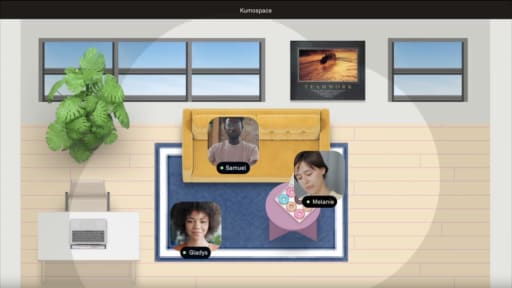
That's where Kumospace does something different. Instead of sticking you in a grid of faces, Kumospace creates actual virtual spaces where you can move around, walk up to people, and have natural conversations. It's closer to being "at" a physical location while still being "in" active discussions.
From attendance to participation
The beauty of Kumospace is that it makes the jump from passive attendance to active participation feel natural. You can see who's around, move over to join a conversation, or step away when you need a break. You're not stuck in a gallery view hoping someone calls on you.
This matters because traditional video calls have this weird thing where everyone’s technically present, but nobody feels particularly engaged. Kumospace fixes that by giving you agency over your own presence, making it ideal for running information sessions. You can be “at the meeting” (in the virtual space) without being “in the meeting” (actively part of a specific conversation) until you’re ready to join.
Enhancing immersive collaboration
What makes Kumospace's approach work is spatial audio and freedom of movement. When you walk closer to people, their audio gets louder. Walk away, and it fades. It mimics real life in a way that makes "being at" and "being in" a meeting feel less like rigid categories and more like fluid states.
Whether you're hosting a team standup, running a virtual event, or just creating a space for your remote team to hang out, Kumospace makes your presence feel more human and less like you're trapped in a Brady Bunch opening.
Possessive precision: 'today's meeting' apostrophe use

Quick grammar sidebar: apostrophes matter, especially in professional settings.
The phrase is "today's meeting" (with an apostrophe), not "todays meeting." The apostrophe shows possession; the meeting belongs to today. The same goes for "tomorrow's agenda," "this week's deliverables," and "Monday's call."
Getting this wrong in a professional email or Slack message isn't the end of the world, but it does make you look less polished. And in written communication, where tone is already hard to convey, little details like this actually matter.
Right: "Can you send me today's meeting notes?"
Wrong: "Can you send me todays meeting notes?"
It's a small thing, but small things add up.
Casual conversations: when 'in the meet' fits

You'll sometimes hear people say "I'm in the meet" instead of "I'm in the meeting." This is super casual, almost slang, and you'll mostly hear it in informal team chats or among close coworkers.
"In the meet" is fine for casual contexts, but don't use it in formal communications. It's like saying "gonna" instead of "going to", totally fine with friends, not great in a client email.
Casual context (fine): "Can't talk rn, in the meet."
Professional context (better): "I'm currently in a meeting but can respond shortly."
Reflecting engagement levels: ‘in' vs. 'at'

Your choice of preposition actually communicates something about your level of engagement, whether you realize it or not.
When you tell someone, "I'm in a meeting," you're signaling:
- Don't interrupt me
- This requires my full attention
- I'm actively participating
When you say "I'm at a meeting," it can sound like:
- I'm here, but maybe not super engaged
- I might be able to respond
- My presence is required, but I'm not leading
This distinction is subtle but real. If you want people to know you're unavailable and focused, "in a meeting" is your best bet. If you're at a larger event or conference where you might still be reachable, "at a meeting" works better.
Summary
Mastering "in" vs. "at" in meeting contexts isn't about being a grammar nerd; it's about communicating clearly. "At the meeting" focuses on location and attendance. "In the meeting" emphasizes active participation and engagement.
With virtual meeting platforms like Kumospace blurring the lines between physical and digital presence, much like a startup office space, the way we talk about meetings is evolving, too. But the core principle remains: be clear about whether you’re just present or actively engaged, and your communication will be stronger for it.
Frequently asked questions
Having a meeting means to have a planned occasion where people come together, either in person or online, to discuss something. For example, "We're having a meeting on Thursday to discuss the problem."
A synonym of "meeting" is "gathering." It can also be referred to as a conference, assembly, or convention.
You should say "in a meeting" when referring to the general time and place, and "on a meeting" when referring to the specific agenda items to be discussed in the meeting. This distinction helps to clarify the context of the discussion.
You can use "in the meet" in casual conversations to describe participation in a meeting.
Kumospace facilitates active participation in meetings by fostering an inclusive environment for all participants, ensuring a smooth transition from attendance to engagement.