Step into the future of work with a hybrid workplace strategy that actually works. As remote work becomes standard, companies are rethinking how to balance flexibility with collaboration. Most employees now prefer hybrid arrangements, and many would consider leaving roles that don’t offer it, making flexibility a key factor in attracting and retaining top talent.
A hybrid model blends remote and in-office work, giving teams the freedom to focus while still enabling meaningful in-person collaboration. It can also reduce costs by lowering office space needs and improving efficiency. In this article, we’ll break down how to build an effective hybrid workplace strategy, explore different models, and show how to make flexibility a competitive advantage.
Key takeaways
- Build a hybrid strategy that aligns business goals, company culture, and employee needs, with clear, outcome-based objectives that prioritize results over presence.
- Choose the right hybrid model and support it with strong guidelines, the right technology, and continuous training to enable seamless collaboration and productivity.
- Address key challenges proactively by ensuring fairness and inclusivity, strengthening company culture, and maintaining clear performance management practices.
- Continuously evaluate and refine your approach using employee feedback and data, while leveraging flexibility as a competitive advantage to attract, retain, and engage talent.
Crafting a successful hybrid workplace strategy

A successful hybrid remote work strategy is born from a careful evaluation of your organization’s needs, a strong alignment with the company culture, and the definition of clear objectives. Well-designed hybrid policies can help attract and retain talent by meeting the growing demand for flexible work arrangements. These vital steps pave the way for a flourishing hybrid work environment that accommodates your employees’ needs and aligns with your organization’s goals.
So, how can you craft the right hybrid model that will lead to better work-life balance and increased employee happiness? Improved productivity and collaboration are just the beginning; hybrid work strategies also allow organizations to expand their talent pool by recruiting from a wider geographic area, gaining access to specialized skills, and enhancing competitiveness.
Aligning with company culture
A successful hybrid workplace strategy should align with your company’s values and culture. Fostering inclusivity, empathy, and trust is essential, especially in distributed teams. A strong workplace culture helps maintain engagement and collaboration across both in-office and remote environments.
In practice, this means applying principles for building a strong culture with a remote team, proactively creating connection points, encouraging communication, and ensuring remote employees feel equally included. Hybrid setups can weaken informal interactions, so intentional efforts like regular check-ins, virtual collaboration, and shared rituals are key to sustaining a cohesive and supportive culture.
An excellent illustration of a virtual team-building activity is the Donut Slack integration. It promotes connections between employees across different teams, encouraging virtual coffee chats or peer learning exchanges. By merging the office and virtual worlds, you give employees the freedom to decide where they work without compromising the positive personal connections and team building essential for a strong company culture.
Defining clear objectives
For a guaranteed successful hybrid workplace strategy, setting clear objectives centered around productivity, collaboration, and employee satisfaction is fundamental. Here are some steps to follow:
- Establish specific, measurable, achievable, relevant, and time-bound SMART goals involving employees in the goal-setting process.
- Make these goals highly visible to all team members.
- Give employees autonomy in achieving their goals, emphasizing employee autonomy as a crucial factor in hybrid work. Allowing individuals to choose how and where they work increases engagement and productivity.
- Check in regularly to monitor progress and provide support.
These objectives should reflect the various ways employees work in a hybrid environment, accounting for different work arrangements and preferences. In hybrid work, focusing on outcomes rather than presence is essential; success should be measured by project completion and results, not time spent at a desk. By following these steps, you can ensure that your hybrid workplace strategy is effective and successful.
Emphasizing employee satisfaction in your objectives paves the way for a hybrid work environment that caters to your employees’ needs and preferences, resulting in improved productivity and collaboration. Remember, defining clear objectives and setting expectations is the foundation of a successful hybrid workplace strategy.
Balancing flexibility and structure in hybrid work models

The balance between flexibility and structure in your organization hinges on choosing the right hybrid work model. The most common approaches include flexible, fixed, office-first, and remote-first models, as well as the virtual office model, in which teams operate fully online without a physical workspace. Each of these models has distinct characteristics, benefits, and challenges. Overall, they can contribute to a more sustainable future by reducing travel and the need for large office spaces.
So, how can you determine which hybrid model is the best fit for your organization? Hybrid work can take different forms, allowing organizations to implement the approach that best matches their specific needs, employee preferences, and work requirements.
Flexible hybrid model
With its consistent schedule for remote and in-office work, the fixed hybrid model guarantees predictability and structure. This approach is often referred to as a fixed hybrid work model, emphasizing its structured and rigid nature compared to more flexible hybrid arrangements. This model outlines specific days or strings of consecutive days for remote work, offering a structured approach to balancing in-person and remote work.
A fixed hybrid model allows remote workers to enjoy the benefits of remote work while still maintaining a predictable and consistent schedule, which can boost productivity and collaboration.
Fixed hybrid model

With its consistent schedule for remote and in-office work, the fixed hybrid model guarantees predictability and structure. This approach is often referred to as a fixed hybrid work model, emphasizing its structured and rigid nature compared to more flexible hybrid arrangements. This model outlines specific days or strings of consecutive days for remote work, offering a structured approach to balancing in-person and remote work.
A fixed hybrid model allows remote workers to enjoy the benefits of remote work while still maintaining a predictable and consistent schedule, which can boost productivity and collaboration.
Office-first hybrid model
The office-first hybrid model prioritizes in-person collaboration while still offering some remote work options. Employees are encouraged to be on-site, with the opportunity to select a few days a week to work remotely. In this approach, the physical office remains the central hub for collaboration, leadership, and company culture, even as flexibility is introduced. This model allows employees to enjoy the benefits of both in-person and remote work, fostering a sense of camaraderie and collaboration while maintaining flexibility.
Companies like Intel, Ford, Spotify, and Microsoft have successfully adopted the office-first hybrid model, reaping the benefits of enhanced teamwork and productivity with their hybrid teams in their office space.
Creating a better work-life balance in hybrid environments
Hybrid work models make it easier to balance professional and personal life by giving employees flexibility in where and how they work. This flexibility supports better well-being, reduces burnout, and increases engagement, especially when employees can manage their own schedules.
To fully realize these benefits, organizations need policies that prioritize flexibility, autonomy, and employee health. At the same time, they must address common challenges like blurred boundaries between work and personal life and potential social isolation.
Practical strategies include setting clear work hours, creating a dedicated workspace, and prioritizing self-care activities like exercise or time with family. Open communication between employees and managers is also essential to identify issues early and adjust workloads or expectations.
Companies can further support balance through wellness programs, flexible schedules, and regular feedback. By prioritizing well-being and recognition, organizations can build a more engaged, productive, and resilient hybrid workforce.
Implementing technology solutions for seamless collaboration

Technology is the backbone of any successful hybrid workplace, but simply adding more tools is not enough. High-performing organizations choose solutions that actively improve employee experience, maintain productivity across locations, and create a sense of connection between distributed teams. Real-time collaboration tools, secure remote access, and engagement platforms must work together as a cohesive system, enabling employees to communicate, share, and collaborate from anywhere without friction. As hybrid work becomes the default, investing in the right technology stack is no longer optional; it is a direct driver of performance, retention, and operational efficiency.
How to Power Collaboration That Feels Human
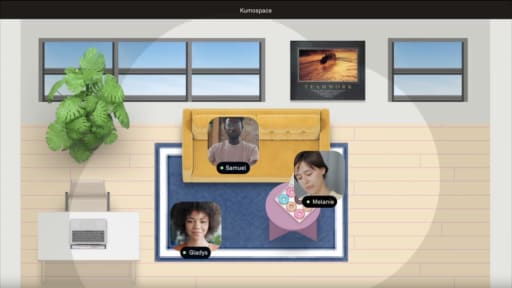
Kumospace stands out as a purpose-built solution for hybrid and remote collaboration, helping companies move beyond static video calls into truly interactive work environments. It combines online meetings, video conferencing, and a virtual office into one seamless platform where teams can collaborate naturally, host engaging virtual events, and run webinar-style sessions at scale. This creates a more dynamic and inclusive experience that keeps employees engaged, aligned, and connected throughout the workday.
By enabling spontaneous conversations, real-time collaboration, and immersive team interactions powered by spatial audio, Kumospace strengthens both productivity and workplace wellness. Instead of juggling disconnected tools, organizations can centralize communication, increase participation in team activities, and reinforce culture in a way that feels intuitive. For companies looking to make hybrid work actually work, Kumospace delivers a clear competitive advantage by turning collaboration into a consistent, high-impact experience.
Best practices for transitioning to a hybrid work environment

Adopting best practices is essential for a smooth and successful transition to a hybrid work environment. Start by establishing clear guidelines for communication, collaboration, and performance so employees understand expectations, team norms, and how work gets done across locations. Defining core collaboration hours, response times, and meeting norms helps reduce confusion and keeps teams aligned.
Providing training and ongoing support is equally important. Employees need to feel confident using collaboration tools and navigating hybrid workflows, so organizations should offer onboarding, tool-specific training, and access to support resources. Regular manager check-ins also help address challenges early and ensure employees feel supported in both remote and in-office settings.
Organizations should continuously evaluate and refine their hybrid strategy based on employee feedback, industry trends, and evolving business goals. Collecting input through surveys, performance metrics, and team discussions allows leaders to identify gaps and make informed adjustments. This ongoing iteration ensures the hybrid model remains effective, scalable, and aligned with company objectives.
Hybrid work also delivers meaningful business advantages. It expands access to a broader talent pool, increases flexibility for employees, and reduces costs tied to real estate and office operations. Many organizations also incorporate coworking spaces or redesign offices to better support collaboration and team connection when employees are on-site.
By combining clear expectations, strong training and support systems, and a commitment to continuous improvement, companies can build a hybrid work environment that is productive, flexible, and sustainable over the long term.
Summary
A strong hybrid workplace strategy blends remote and in-office work to improve productivity, flexibility, and talent retention. As employees increasingly expect hybrid options, companies that offer well-structured flexibility gain a competitive edge in attracting and keeping top talent while reducing costs and expanding access to global skills.
Success depends on aligning the strategy with company culture, setting clear outcome-based goals, and choosing the right model, whether flexible, fixed, or office-first. Organizations must also prioritize inclusivity, maintain strong communication, and support work-life balance to ensure consistent performance across distributed teams.
Technology is essential for seamless collaboration, with integrated tools enabling communication, engagement, and teamwork across locations. Continuous feedback, training, and iteration help refine the approach over time, allowing companies to build a scalable, high-performing hybrid environment that supports both business goals and employee well-being.
Frequently asked questions
The four pillars of hybrid working are creating a clear purpose for returning to the office, ensuring inclusivity for all workers regardless of where or when they work, developing team working models, and providing easy access to development. These enable organizations to create an effective and inclusive hybrid work environment that benefits all employees.
A hybrid workplace model is a flexible work model that supports a blend of in-office, remote, and on-the-go workers. It offers employees the autonomy to choose to work wherever and however they are most productive while employers benefit from having a more productive, healthy, and stable workforce.
To create a successful hybrid working model, employers should prioritize flexibility and accountability, provide space for meetings and shared work, and encourage social engagements between all employees in the office and remote settings. Leaders should also demonstrate best practices of hybrid working by doing it themselves.
A hybrid work model can effectively boost employee satisfaction and productivity by providing flexibility, autonomy, and work-life balance.
Tools such as Kumospace, remote access software and employee engagement platforms enable effective communication and collaboration for hybrid work environments. With Kumospace, features like virtual whiteboards, interactixve presentations, and customizable virtual spaces empowers teams to work together creatively and efficiently, regardless of their physical location.